Scale-Across and the Rapid Expansion of DC-to-DC Links for AI
Published: November 19, 2026
This is a guest article from Alan Weckel, Co-Founder and Principal Analyst, 650 Group
Scale-out is the rack-to-rack network fabric that enables large XPU clusters inside a single building to work in synchronicity. However, AI factories no longer fit in one building or one location. Power, land, and cooling constraints are spreading GPUs and XPUs across buildings and neighboring campuses. Scale-across is the fabric that connects those sites into a single unified accelerated compute cluster, and it is now one of the fastest-growing layers in data center networking.
Cloud networks have always had data center interconnect (DCI) between buildings and campuses, but these pipes were thin, with only low single-digit percentages of traffic leaving the data center. Links are too expensive and too few, and limited bandwidth between buildings leads to lower utilization and cluster fragmentation. Multi-building and multi-campus training has led to much more DC-to-DC bandwidth, and today scale-across allows model builders to reach and eventually exceed 1M GPUs. As hyperscalers and neoclouds expand their geographic footprint in the chase for power, scale-across will become an increasing percentage of links and a significant revenue contributor to the networking market. Furthermore, while today’s scale-across is focused on AI training including reinforcement learning (RL), scale-across will quickly become a huge opportunity as agents become the majority of traffic entering and leaving data centers.
Why Scale-Across is Growing So Quickly Now
The first AI wave packed accelerators into a single hall/building. That model is breaking. Frontier training and large inference pools need hundreds of megawatts, and few sites can deliver that power in one building or within one municipal power grid. Behind-the-meter (self-power) adds an additional dynamic to build locations. The answer is to treat a campus, then nearby campuses, as one logical factory. Mixture of Experts (MoE) models, large context windows, and agentic workflows create traffic that cannot stay inside one hall. Operators need high-bandwidth, low-jitter links across 10 to 40 km (Coherent Lite), 60 to 100 km (ZR), and 100 km+ (ZR+) so a job can span buildings, municipalities, and metros.
Connecting Buildings and Campuses is Now Core Architecture
Hall-to-hall fiber, building-to-building spans, and campus-to-campus links have gone from niche to massive conduit as operators prepare for more traffic. A hyperscaler may stitch several buildings into a cluster of hundreds of thousands of GPUs. A neocloud or sovereign operator may link two or three sites so one job has enough power. Traditional DCI moved replication, frontend traffic, and recovery. Scale-across carries the backend fabric itself. Bandwidth leaving each building is no longer a small percentage.
DCI Moves From Niche to a Multi-Billion Market This Decade
Ethernet DCI spent years as a specialized slice of switching, routing, and optics, with volumes well under one million ports a year. AI changes both the size and shape of demand. Scale-across is incremental to the AI networking TAM and traditional DCI opportunity we already track. Switching, routing, optical transport, ZR, ZR+, and Coherent Lite optics push interconnect into multi-billion-dollar territory this decade, with scale-across as the steep part of the curve. Each new campus generation multiplies the high-speed ports that must leave the building.
Port Volume Forces a Different Approach
Historically, DCI was a router-only function leveraging deep buffers. In the early 2020s, that moved to switching and high-density router platforms as the links could not be supported by sub-30-port line cards. While there was a mixture of fixed and modular platforms, volumes leaned towards modular because of the larger port counts and deeper buffers. These low-volume deployments could absorb a purpose-built chassis and a long qualification cycle. However, AI scale needs merchant silicon, pluggable form factors, multi-source optics, and platforms ordered at data center tempo. It is likely a single hyperscaler could order more scale-across ports in a year than the entire router market services across all use cases. Thus, many hyperscalers are now designing scale-across architectures with shallow-buffer, fixed-form-factor designs that can be deployed at scale with the appropriate cost structure.
Higher Radix Switches Enable a Converged Spine
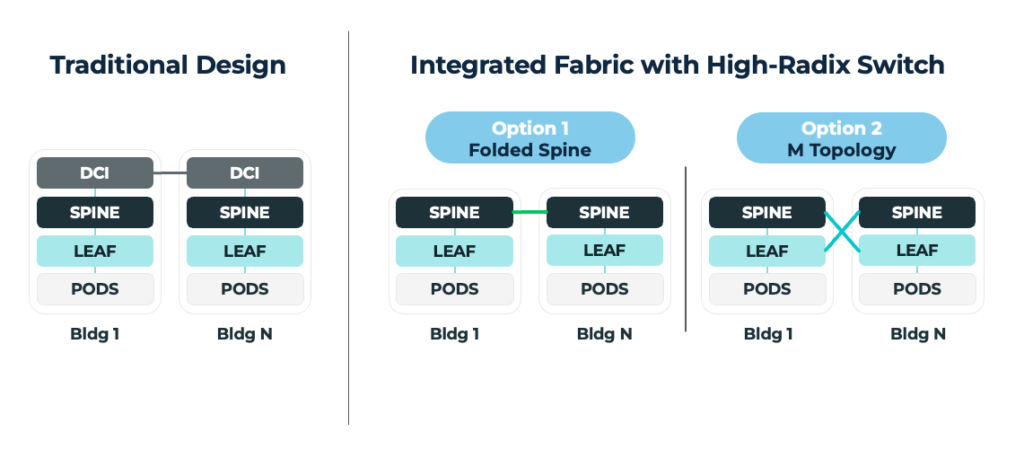
The DCI layer has historically been deployed as a stand-alone layer with modest interconnect volumes. Even with the move to high-volume deployments using fixed-form-factor switches, the current DCI designs are a separate layer due to the limited radix of available switches. This gets expensive when thousands of 800G and 1.6T ports leave each building. Significantly higher-radix switches let the spine switches take scale-across ports directly and fold that traffic into the Ethernet aggregation/spine layer that already serves scale-out, for example, as shown in Figure 1 below. Reducing a layer of switches and the associated fibers and transceivers to interconnect the layer below creates significant cost savings. Every building-to-building AI link does not need its own DCI layer, and higher-radix boxes can support the collapse in layers.
Coherent Lite Unlocks Cost-Efficient 10 to 40 km Links
PAM4 LR optics work great inside the building and across short campus spans, but they run out of link budget as rates climb and distances move toward 10 km and beyond. Full ZR and ZR+ optics solve metro reach, but cost, power and latency are hard to justify on a 10 to 40 km link. Coherent Lite keeps the coherent optical budget while stripping functions that long-haul needs and campus links do not. Operators can light many parallel campus fibers and reserve ZR and ZR+ for longer regional ties. We expect a significant adoption curve in this new class of optics once products hit the market. As a preview of our forecast, the scale-across market for Coherent Lite optics will exceed $10B and 20M modules by the end of the decade, while the switching platforms add roughly the same amount of revenue. This is all incremental TAM to the ZR/ZR+ scale-across market and the non-AI DCI market. Adding everything together, the DCI + Scale-Across market is on track to be a $100B market as we look into the early 2030s.
Hyperscalers are Chasing Power, and Scale-Across Follows the Footprint
Hyperscalers are adding campuses where megawatts are available. A short distance can reach a different power grid. For example, if you look at the SpaceX Colossus data center, it literally sits over the border of two states. The same operators who standardized Ethernet for scale-out are now standardizing how that fabric leaves the building to connect multiple buildings and campuses.
2nm 1.6T Coherent Lite in 2028 Significantly Increases Market Size
The product that turns this into a volume market is the 1.6T Coherent Lite optic on a 2nm-class DSP, ramping in 2028. That generation lines up 1.6T switch ports, campus distances PAM4 cannot cover cleanly, and a cost and power envelope that supports tens of millions of ports. 800G started the scale-across market; 1.6T is where volume and economics meet.
Conclusion
Scale-across is the next major expansion of AI networking. Clusters have outgrown the building, and the links between halls, buildings, and campuses decide whether GPUs run as one factory or as stranded islands. DCI is becoming a multi-billion-dollar market this decade because AI traffic, not backup traffic, is what now leaves the data center. Coherent Lite unlocks a part of the market above PAM4 and below ZR and ZR+. Importantly, high-radix Ethernet switches can use their abundance of ports to collapse the scale-across layer and spine layer into a single tier of switches, enabling new cost-efficient and highly performant multi-building and multi-campus architectures. As scale-across moves towards mainstream and millions of ports, the architecture will need to adapt to be cost-efficient and volume-ready.
About the Author
Alan Weckel is co-founder and Principal Analyst at 650 Group. With nearly 25 years in the industry – in research and in engineering, Alan’s expertise has been quoted in CIO Today, Wall Street Journal, and Fierce Telecom. He has presented at a wide variety of industry and finance events, including Citibank, Deutsche Bank, IEEE and Ethernet Summit. His work at previous companies including Cisco Systems, Dell’Oro Group and Raytheon provide a foundation for his deep knowledge of the industry and its supply chain.