How High-Radix Switching Breaks Through AI’s Network Wall
Published: November 3, 2026
Let’s start by acknowledging an inconvenient but painful truth: Traditional data center network architectures have not kept pace with the scaling needs of AI computing.
The causes and implications of that reality were discussed in the recent OCP Educational Webinar, “Breaking Through the AI Network Wall with High-Radix Switching” by 650 Group’s Alan Weckel and Eridu’s Promode Nedungadi.
Their discussion noted how AI has strikingly redrawn the parameters of data center networking. Whereas cloud computing data centers converged on a single fabric built to handle unpredictable traffic from a large array of independent workloads, AI workloads have very different demands that require a very different fabric. Scale-up, scale-out, and scale-across networking require much higher performance and lower latency to handle 10-100x more traffic in highly synchronized operations connecting up to hundreds of thousands of compute endpoints (GPUs/xPUs).
Conventional network architectures can only meet growing bandwidth and scale requirements by adding more network tiers, resulting in thousands of switches as well as additional optics, cabling and more. The resulting network sprawl increases latency, costs, power consumption, and operational complexity. Increased latency is a particular problem, seriously compromising AI processing, but slower deployments and decreased network reliability are also important consequences of this network sprawl.
With AI’s massive scale and rapid growth, networks have become a significant bottleneck, creating a “network wall” that restricts GPU/xPU utilization and inhibits AI value creation.
The Need for a New Network
To break through this network wall and liberate AI computing, the network must be reimagined comprehensively, from network silicon to network systems (switches) and software. There is no other way forward–the current cadence of evolutionary advances in network silicon and architecture cannot meet current and future scale-out, scale-up, and scale-across needs.
At the heart of the solution? High-radix switching. High-radix switches—not just a little higher, but 10x more than today’s systems–are needed for the network to catch up to and keep up with the accelerating pace of xPUs.
With commensurate advances in network silicon and switches, AI models can leverage larger clusters running on flatter, simpler networks, including extremely high-bandwidth scale-up domains.
Benefits Abound
High-radix switching unlocks not only performance benefits such as reduced latency, less congestion, and higher reliability. It also delivers operational benefits that include the need for less cabling, as well as simpler network deployment and ongoing management. Just as importantly, high-radix switching delivers economic benefits including higher GPU utilization, lower costs, and reduced power consumption.
In the bigger AI picture, the result is improved outcomes through enhanced model intelligence, faster training, and reduced cost per token.
To quantify the potential impact of high-radix switching on AI workloads, a recent paper presented at Hot Interconnects conducted a simulation of a large scale-up domain with 5,120 GPUs running a training workload for a 20T-parameter Mixture of Experts (MoE) model. It compared performance using a hypothetical 1 Pbps switch with a baseline using a future 230 Tbps switch—already 2x the bandwidth of the 102.4 Tbps generation of switches just beginning to come to market.
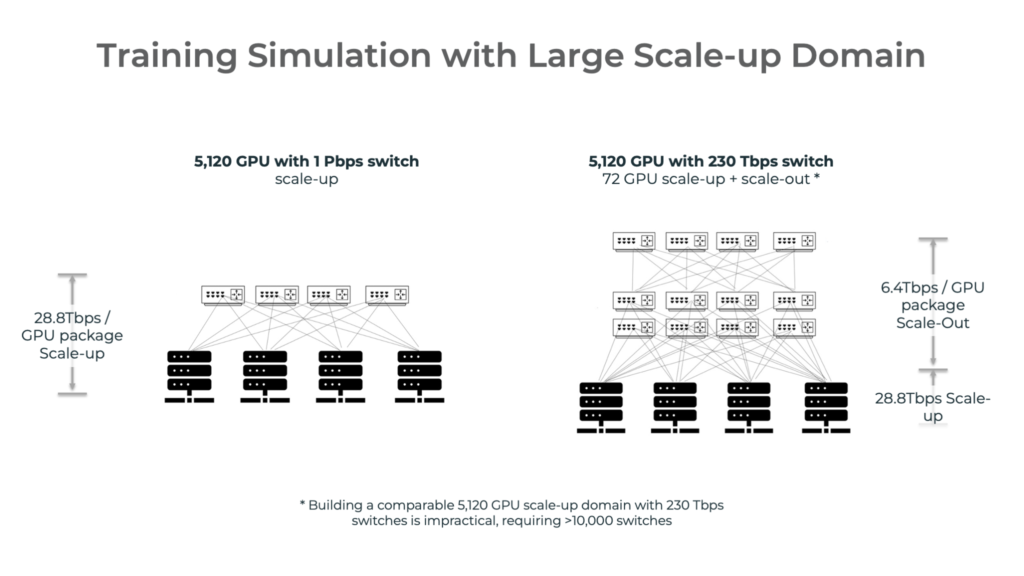
The first observation is that even the next generation of network switches would be impractical for building a single scale-up domain of that size as the network would require more than 10,000 switches. Instead, the paper simulated a more practical architecture using 230 Tbps switches, connecting multiple 72-GPU scale-up domains with a scale-out network. Traffic crossing the scale-out network experiences lower throughput and higher latency due to multiple switch hops. Conversely, with high-radix 1-Pbps switches, the same 5,120-GPU domain can be connected in a single-hop, scale-up network.
That provides not only substantial benefits in cost, latency, and operational simplicity, but also much faster job completion and higher GPU utilization.
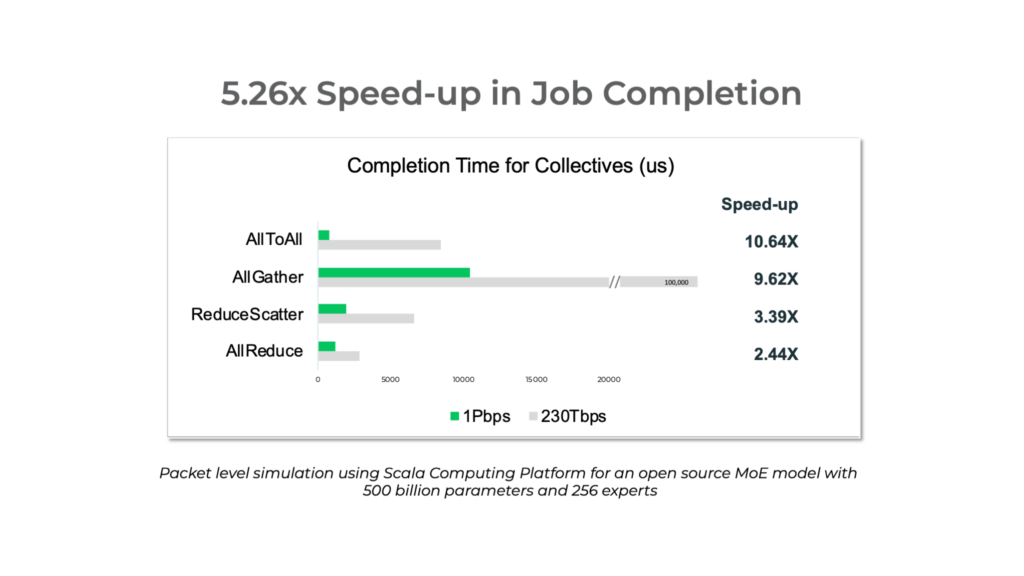
- In all-to-all processing, for instance, 1-Pbps switching would deliver a more than 10x speed increase, with All-Gather communication benefiting from speed-up of nearly 10x.
- Speed-up improvements would also accrue to ReduceScatter communication (more than 3x) and AllReduce (nearly 2.5x)
- In aggregate, 1-Pbps switching would deliver a 5.26x speed-up in job completion and 38% higher GPU utilization.
To learn more about this simulation and how Eridu is breaking through the network wall with innovations in switching silicon, systems and software, watch the OCP Educational Webinar, “Breaking Through the AI Network Wall with High-Radix Switching.”